
IS IT GRAPHOMANIA?
Poets, posers, and ... Treebeard?

Graphomania. I had never heard this word until my husband said it. We were watching the extended edition of The Lord of the Rings. He had never seen those scenes where Treebeard is carrying Merry and Pippin to the Entmoot. In the book as in the film, Treebeard bores the hell out of the hobbits with unsolicited recitations of his poetry. The poetry is bad.
“The tree’s a graphomaniac!”
“A what?”
“You know? I’ve told you before – those people who can’t write but feel compelled to do so?”
Reader, have you suddenly grown cold?
Graphomania is clearly a Greek-originated word, therefore its meaning should be obvious in all Indo-European languages. Writing-mania. Someone who writes nonstop, about everything. Yet the word carries an additional context, that being: they shouldn’t.
Let me give you an example. As stated, I never heard “graphomaniac” used until recently, but I always knew how to identify a poser.
In my university days I spent a phase reading my poetry at literary open mic events. My poetry back then was bad, and it tended more towards spoken word. It garnered great responses because it was buzzy, and I treated the whole thing as low-brow performance art. I never read aloud any words that meant something to me.
At these open mics there were two regulars. Warboy and Squit. Warboy did intense spoken word poetry. He performed with all the faux-dramatic pathos of an autistic fifteen-year-old doing Hamlet monologues. He tended towards trendy politics and the fetishization of the working class man. George Orwell deals aptly with the likes of Warboy in Part Two of The Road to Wigan Pier.
Squit, being a girl, took an active role in organisation. She always read several poems at each event. I do not recall any of them.
These two were quick to proclaim themselves as Poets. In fact, I have more memories of them doing this than of them reading, writing, or even discussing poetry. Their identities as Poets preceded them in our English department as well as online, where we were forever bombarded with their self-promotion.
Warboy of course secured a publishing contract, and at least one of his collections spent time on sale in the nation’s most identifiable chain bookstore. He marketed this blessing intensely. I stress that I cannot name even one of his poems. I can only recall the mock-grandeur of his droning cry during open mic at the Student Union. Is this graphomania?
Squit is more egregious. She hungered after fame but lacked the social inequality outrage aesthetic. Nothing actually outraged her other than her lack of accolades. She spent her time creating seemingly well-intentioned initiatives for the purpose of driving attention towards artists like herself. Not once did I hear her mention literature. As with Warboy, I can’t recall a single one of her poems.
After graduation she appeared in a run of television advertisements for savings accounts offered by a well known bank. Her voice reading aloud excerpts from one of her poems provided the thematic backdrop for the ad’s message. The word “rainbows” was used. Looks like Squit had made it.
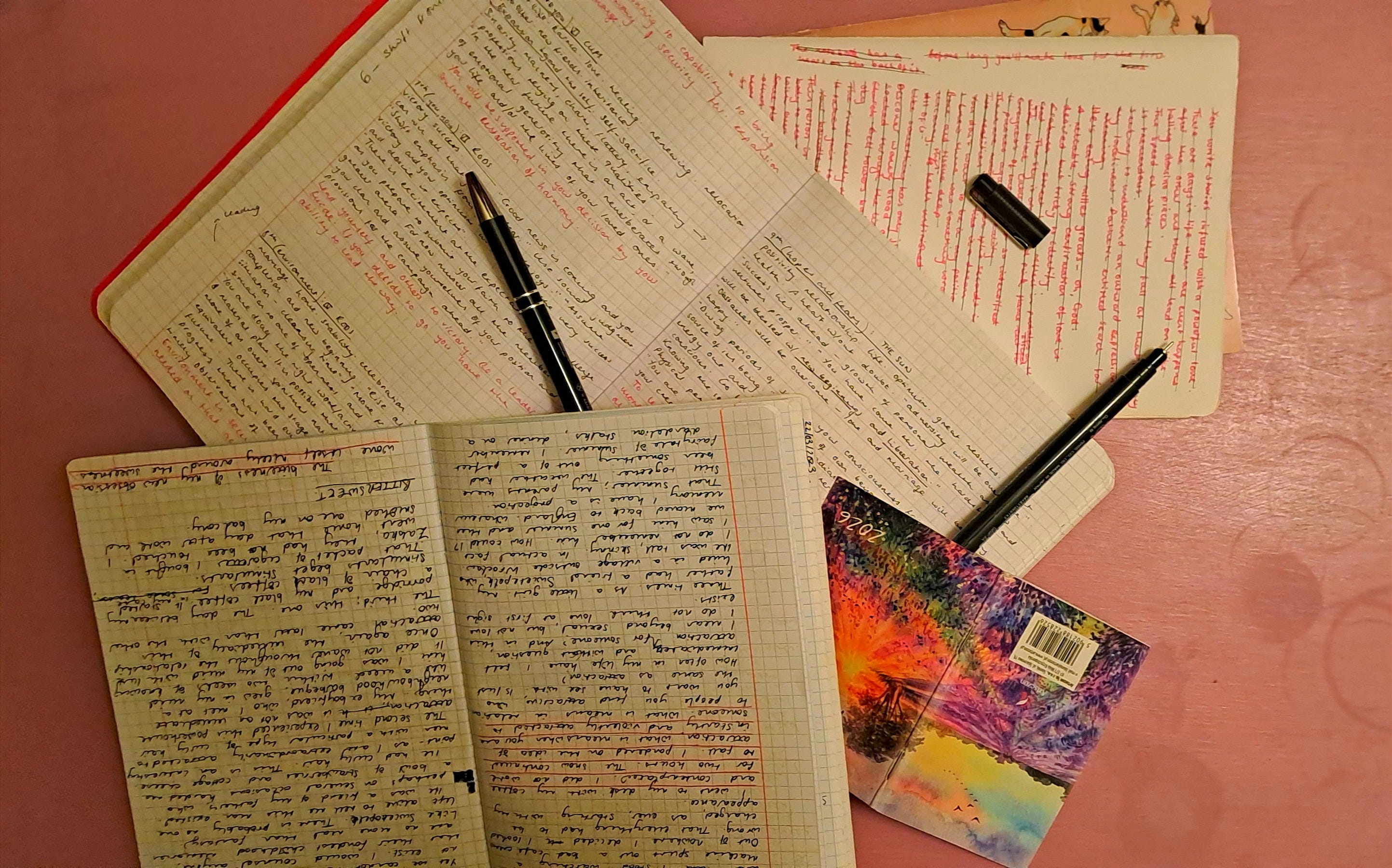
I have a compulsion to write. I begrudgingly accepted it in my mid-twenties. I had tried to forget this thing I kept turning back to, the one thing capable of restabilizing my regularly unbalanced form.
I stopped myself from looking anyone in the eyes and telling them, quietly: “I am a writer”, until 2019. Before then I’d been met with pitying nods, feigned surprise, awkward smiles, and indifference. Nor did I know anyone who wrote. Two girlfriends who did Creative Writing at my university stopped producing work for me to read post graduation. Neither did anyone deliver on their promises to read and critique my work unless I forced it on them, like Treebeard (although I don’t think he wanted critique). I sank into my hidden realm of writing, not daring to declare myself for fear of those unsettling reactions. I wanted support but eschewed all thoughts of self-promotion. That is where the distinction lies. A graphomaniac is compelled to write and simply has to tell you that they do, not to develop their skill but to be applauded.
No one does gentle scathing like the English. In his novel Antic Hay, Aldous Huxley presents us with the character of Casimir Lypiatt. “Painter, poet, musician,” Lypiatt declares, “I am all three.”
No one names Lypiatt a graphomaniac – I’m fairly sure in English-speaking countries this term is never used – but he has all the hallmarks of one.
“Lypiatt began to describe the pictures there would be at his show; he talked about the preface he was writing to the catalogue, the poems that would be printed in it by way of literary complement … He talked, he talked.”
Talking, the great giveaway. Warboy did it. He made Facebook posts presenting his bulk-buying of sandwiches to give away to the homeless people of Brighton. A “complement” to his socially-minded poetry.
Graphomania scares me. I myself can know I’m not a hack, but graphomania is a more sinister disease. The patient does not seem to be aware they are infected.
One must have pride in their own work, especially if it’s laboured over. The lack of a publishing contract does not mean lack of talent, especially in today’s market. Nowadays, one has to be one’s own promoter, marketing manager, and content creator. The new publishing world order may make graphomaniacs of us all.
The poet and translator Feliks Netz used to regularly publish my husband’s work. Upon first submitting poetry to him, Netz’s response had been: “Well, it’s not graphomania.” No better feedback could ever be given. Netz was clearly a frequent receiver of graphomaniacal work.
I ask my husband: “Am I a graphomaniac?” I know this is dangerous, would be better to ask him if I’m the prettiest girl he’s ever seen. He replies in the negative. He can’t give an adequate definition of graphomania, only that I’m not it and Treebeard is.
Reactions to Treebeard’s (and others’) work might be the key to identifying graphomania. If your stuff goes on and on, is centered entirely around You, makes hobbits irritable, then you might be in graphomania territory.
The Bosnian writer Semezdin Mehmedinović recently penned a new book, Mali roman o tišni (Little Book of Silence). Of it he says: “All my life I’ve been transcribing my dreams”, which certainly sounds like graphomania. Dreams being the most self-indulgent of all literary indulgences. Yet I can assure you that if any writer is going to transcribe dreams, it ought to be Mehmedinović. As far as I’m concerned he’s entitled to publish a collection of every dream he’s ever had, then move onto his shopping lists and memorandums.
I continue to feel anxiety regarding this frightening term. It is as uncomfortable to watch people afflicted by it as it is to consider whether you show symptoms of it yourself. We’re all told to ask ourselves: am I the toxic friend in the group? Whilst reminded that the actual toxic friend would never ask that question.
The same goes for graphomania.
You mention the concept of talent in this article. I am curious. Why do you believe such a thing as "talent" exists? if you do.
Here is my loose thoughts for the disbelief of talent: Individuals have innate inclinations towards certain modalities of expression, but this does not imply the existence of a metaphysical concept such as talent. Talent is, at best, a layman's excuse for the refusal of doing conscious labor in whatever art or science they are uninclined in.
I would sincerely like to hear your thoughts on this.